
By
David W. Johnson
Presented At 1999 International Conference and Workshop on Modeling Consequences of Accidental Releases of Hazardous Materials San Francisco, California September 28 – October 1, 1999
Abstract
The RELEASE model is a significant step forward in the prediction and modeling of superheated liquid releases. The RELEASE model was the end result of a multi-year research program sponsored by the Center for Chemical Process Safety. RELEASE computes the amount of vapor, aerosol, and liquid produced when a superheated, pressurized liquid is released into the atmosphere. RELEASE takes into account many of the variables that are known to affect the amount of each of these releases, such as the amount of superheat, the velocity of release, the physical properties of the material released, etc.
RELEASE was developed to model horizontal releases of pure components. The model does not take into account droplet vaporization during the release trajectory. A second shortcoming of the model is its restriction to pure components. Since many superheated releases involve mixtures, the usefulness of the model is limited. This paper discusses how the RELEASE model can be improved to include the effects of droplet evaporation during the release trajectory. Comparison of the RELEASE model calculations to experimental data, with and without the RELEASE enhancements, will be presented. In addition, a method for handling the thermodynamics of mixtures will be outlined.
Text
Introduction

In 1980, a series of radiation and dispersion experiments were conducted using both subcooled and ambient temperature propane [DOE, 1981]. During these experiments, some small-scale releases of superheated propane were made. These experiments provided evidence that the release of a superheated hydrocarbon could result in the formation of an aerosol. Several years later, much larger-scale tests were run with ammonia and hydrogen fluoride. The results were similar; little material accumulated on the ground, even though only a fraction of the liquid flashed upon release.
As a direct result of these large-scale fluid releases, the Center for Chemical Process Safety (CCPS) began a multi-year effort to develop and validate a fluid release model. The result of this effort is RELEASE, the model that will be discussed in this paper. The RELEASE model has the capability of predicting the rate of fluid release, the behavior of the fluid prior to and after entering the atmosphere, and the dilution of the material in the near field. The discussions and development presented in this paper deal only with the RELEASE model’s ability and usefulness in predicting the behavior of fluids upon release from containment. A detailed description of the model’s development, the validation and improvements of the model, all reports dealing with the development of the model, and the experimental data, as well as source code and executables, can be found in RELEASE: A Model with Data to Predict Aerosol Rainout in Accidental Releases [Johnson and Woodward, 1999].
Development of the RELEASE Model
Liquid release models available in 1986 predicted that all of the unflashed liquid would fall to the ground and form a liquid pool. The Center for Chemical Process Safety (CCPS) realized that a liquid release model was needed that would correctly predict the amount of liquid that could be retained in the vapor phase as small aerosol sized drops. The CCPS also realized that a pool of experimental data would need to be developed so that liquid release models could be validated and improved by direct comparison with experimental data. In 1988, the CCPS contracted with CREARE Inc., to develop a liquid release model. This model, now known as RELEASE, was finished in 1988 [Ianello and Childs, 1988; Iannelo, Wallis, and Rothe, 1998]. In 1989, work began on an experimental program to provide data to test and improve the RELEASE model. The first two fluids studied were water and CFC-11 (chlorotrifluoromethane). They were selected because of their ready availability and their relative nontoxicity. In 1991, additional liquids were studied, including cyclohexane, chlorine, and methylamine.
When experimental data became available [CCPS, 1990; CCPS, 1992], the RELEASE model was tested against the “corrected” experimental data. The results, shown in Figures 1 through 4, were not encouraging. The RELEASE model predicted much higher amounts of liquid falling to the ground than were actually measured. The “corrected” data represent the experimental values after correction for such effects as liquid evaporation before collection and drop evaporation before reaction in the capture system. In these figures, the term “Rainout” means the amount of material exiting the orifice that reaches the ground, and “Superheat” means the difference between the storage temperature of the liquid and its atmospheric pressure boiling point.
Figure 1
Comparison of RELEASE Prediction with CFC-11 Experimental Data

Figure 2
Comparison of RELEASE Prediction with Chlorine Experimental Data

Figure 3
Comparison of RELEASE Prediction and Cyclohexane Experimental Data
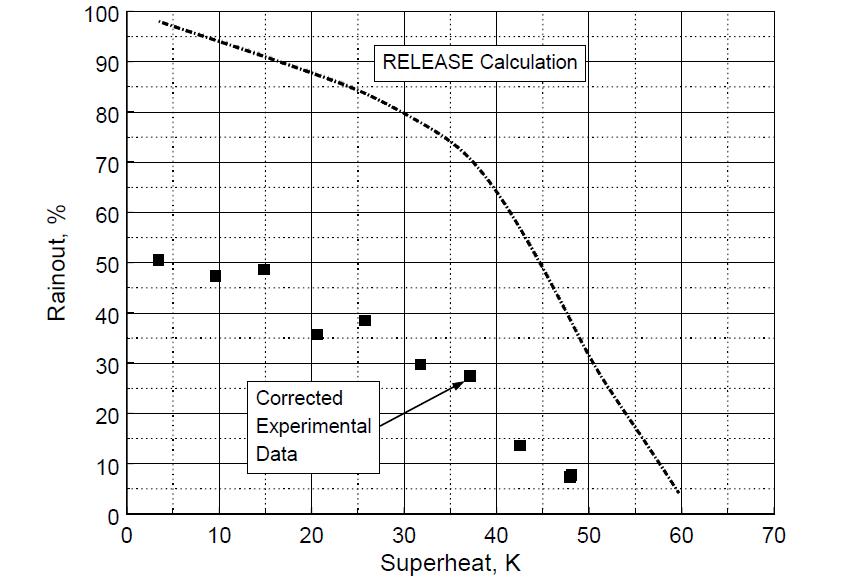
Figure 4
Comparison of RELEASE Prediction and Methylamine Experimental Data

How the RELEASE Model Computes Aerosol Formation
The RELEASE model computes the amount of liquid that travels with the vapor cloud (aerosol) and the amount of liquid that falls to the ground (rainout) by determining the average size of the liquid drops that are formed during a liquid discharge, finding the minimum drop diameter that will fall to the ground (critical diameter), and integrating the drop size distribution to determine the mass of liquid above (rainout) and below (aerosol) the critical diameter.
The critical drop diameter is the smallest size liquid drop that will have sufficient terminal velocity to escape the vapor/liquid jet issuing from the release orifice. The RELEASE model uses two methods of computing the average drop size and then selects the smallest as the critical diameter. For either drop formation mechanism, the average diameter is found using the Weber number relationship:
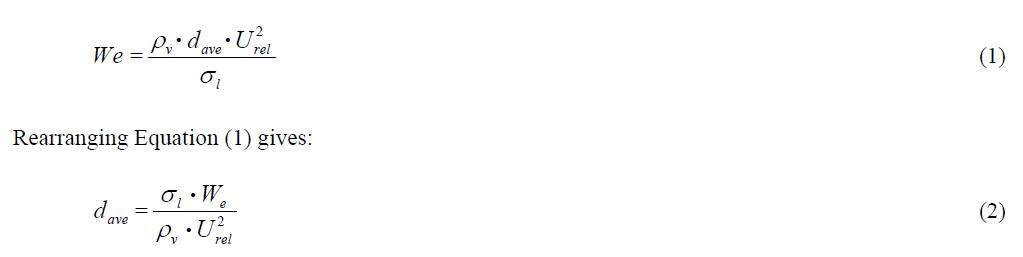
The value of the Weber number used in Equation (2) is known as the threshold Weber number. The threshold Weber number, assumed to be drop size independent, is frequently assumed to have a value between 10 and 14.
The liquid stream exiting the orifice is assumed to break up, either 1) due to drag forces between the liquid and the ambient air, or 2) by the action of the expansion and acceleration of the liquid as it flashes after exiting the orifice. In breakup due to drag forces (mechanism 1), the relative velocity used in Equation (2) is:
Urel=Ud-Uair
Equation (3) assumes that the liquid and wind vectors are in the same direction. If they are not, then the component of the liquid velocity in the horizontal direction should be used.
The relative velocity used for flashing breakup (mechanism 2) is found using:

The smaller of the two average diameters calculated using the relative velocities found in Equation (3) or Equation (4) is selected for use as the average drop diameter.
To determine which drops eventually fall to the ground and which drops remain in the vapor stream, a critical velocity is computed and compared to the terminal velocity of a drop. The critical velocity is the vertical component of the release stream assuming a stream spread half angle of 4.77 degrees. The critical velocity is computed as:

Equations (6), (7), and (8) are solved iteratively for the critical drop diameter above which drops will fall to the ground.
To proceed further, an assumption is made regarding the distribution of drop diameters in the release stream. The RELEASE model assumes that the drop size distribution is given by a log-normal distribution:

Based on experimental work done on flashing releases of freon [Liles, et al., 1986; Tan and Bankoff, 1985], the geometric spread, σ g , is expected to be within the range of 1.4 to 2.0. The original CREARE develop-ment suggested using a value of 1.4. A typical log-normal distribution predicts that no drops will have negative diameters and that the maximum in the distribution will occur at the value of the average droplet diameter. Figures 5 and 6 show how changing the value of the geometric spread and average drop diameter change the shape of the log-normal distribution.
The rainout fraction is found as follows:

The numerator in Equation (10) is proportional to the mass of liquid with drop diameters below the critical diameter, i.e., the mass of material that will not fall to the ground. The denominator is proportional to the total mass of liquid exiting the orifice.
It is obvious from the preceding development that two important areas were not pursued in the original RELEASE development: 1) evaporation of liquid drops falling to the ground, and 2) prediction of the path or trajectory of the liquid drops. These areas were not developed because they were not called for in the scope of work. Later in this paper, a method of dealing with evaporation and trajectory will be developed.
The Corrected RELEASE Model
There was no obvious reason that the RELEASE model did such a poor job of predicting the release behavior of the superheated releases studied experimentally. Without going into any detail of the theoretical development, the inability of the RELEASE model to predict the experimental data was the result of two factors, only one of which was an actual error in the model development. As shown in the previous figures, the original RELEASE model always predicts larger amounts of liquid falling to the ground than was experimentally observed. This is because 1) no liquid drop evaporation is allowed in the model, and 2) the model incorrectly integrated the log mean distribution function to obtain the fraction of liquid released that reached the ground. No liquid evaporation implies that all of the liquid falling to the ground actually reaches the ground. As Figures 1-4 show, only 55-65% of the liquid starting to the ground actually reaches the ground for a horizontal release at 4 ft above grade (the experimental conditions of release). However, drop evaporation alone cannot account for the large shift to the right in the release curve shown in the figures. It was through a fortunate set of circumstances that the cause of this problem was discovered.
Figure 5
Log-normal Probability Distribution with Varying Geometric Spread

Figure 6
Log-normal Probability Distribution with Varying Average Drop Diameter

The CREARE report did not clearly develop the integration shown by Equation (10). The actual results of the integration were shown in one of the source code subroutines. An examination of the reference to the closed form solution of the integration (a relatively difficult to obtain handbook of mathematical functions [Abramowitz and Stegun, 1965] failed to show the formulation as found in the source code. This prompted the author to take a closer look at the integration and compare the source code to the development outlined in the CREARE report. The result of the comparison showed that the source code was actually computing a diameter-weighted fraction instead of mass-weighted fraction. The mass of an individual drop of liquid is:

Since the value of the leading term in Equation (12) is a constant, the final form of the integration is:

A more detailed presentation of the analysis is given by Johnson and Woodward [1999].
When the correct integration is placed in the model, the RELEASE model results shown in Figures 7 through 10 are produced. As the figures show, computed rainout using the correct integration places the predicted RELEASE curve directly above the corrected experimental data.
Dealing With Drop Evaporation
The next step in improving the RELEASE model is to approximate the amount of liquid that evaporates as drops fall to the ground. Before starting this task, a brief description of the organization of the RELEASE model source code is presented. RELEASE is written in Fortran 77 (Ryan McFarland) and has been successfully compiled using Microsoft, Lahey, and Unix Fortran compilers. The source code contains no unusual or machine-specific Fortran implementations and is well documented. Source code was supplied to the CCPS for all but the data input (Main) section of the program. This presents only a slight inconvenience as source code is provided for all of the needed modeling subroutines. The modeling is developed in a logical sequence of engineering source code subroutines. The subroutine names pertinent to this discussion and their functions are:
- PROP.FOR
- Computes pure component physical properties using the DIPPR database.
- CHOKE.FOR
- Computes the rate of release of material from a circular orifice for choked and unchoked fluid flow.
- EXPAND.FOR
- Computes the behavior of the released fluid as it depressurizes to atmospheric pressure.
- ATOM.FOR
- Computes the average drop diameter using Equations (2), (3), and (4).
- RAIN.FOR
- Computes the critical drop escape velocity and performs the integration toobtain the mass fraction of drops falling to the ground.
Figure 7
Comparison of Corrected RELEASE Prediction and CFC-11 Experimental Data

Figure 8
Comparison of Corrected RELEASE Prediction and Chlorine Experimental Data

Figure 9
Comparison of Corrected RELEASE Prediction and Cyclohexane Experimental Data

Figure 10
Comparison of Corrected RELEASE Prediction and Methylamine Experimental Data

Other modeling subroutines supplied with the RELEASE source code compute the behavior of the momentum jet aerosol/vapor cloud after it has depressurized. Since this paper deals only with the initial release behavior of the stored fluid, the momentum jet subroutines will not be discussed further.
Drop evaporation is a function of the size of the drop, the partial pressure of the fluid in the drop, and the length of time the drop remains in flight. The evaporation rate of a single liquid drop falling through the air is well known. However, the evaporation rate of an ensemble of drops within a vapor cloud that has a vapor concentration that varies both in axial and radial dimensions is much more difficult to compute. As a first approximation, a simplified analysis may suffice. This type of analysis combines trajectory calculations with experimental data to yield a relatively easy to compute, yet accurate, estimate of drop evaporation.
The trajectory of a liquid drop is governed by horizontal and vertical velocity components, resistance of the surrounding vapor, and gravitational acceleration. The time of flight is a function of the vertical component of velocity; the horizontal component is of interest only when the actual point of contact with the ground is needed. For this reason, only the vertical component of velocity will be developed. The starting equation for determining time of flight is:

A downward release would have a release angle of −90 degrees; a horizontal release angle of 0 degrees.
The drag forces can be calculated using the equation:

The time of flight can be found by integration of Equation (14) to give:

Since the required integration involves a nonlinear function of the velocity, the simplest solution may be to perform the integration iteratively by choosing a small time step, computing the change in vertical velocity over the time step, using the average velocity over the time step to find the change in vertical distance, and then moving to the next time step. This procedure is repeated until the drop reaches the ground. The question naturally arises as to how to treat the range of drop diameters as described by the log-mean distribution. Since a simplified analysis is being used, the average drop diameter found from Equation (2) is appropriate.
To estimate drop evaporation, additional information besides the time of flight is required. This information is available from data obtained during the CCPS experimental program. If the corrected RELEASE rainout values are simply multiplied by the factor 0.6, the RELEASE calculations and experimental data come into good agreement. The data indicate that a liquid stored at its normal boiling point and released horizontally from 4 ft above grade will lose 40% of its mass by evaporation. Cyclohexane, chlorine, and methylamine releases reached an equilibrium between heat and mass transfer (i.e., constant temperature of liquid) within
5 ft of the release point [CCPS, 1990]. This indicates that drop evaporation reaches steady state quickly, and further changes in drop evaporation are dominated by changes in the surface area of the drop.
Using the above information, a drop evaporation model can be developed that requires only the time of flight and vapor pressure of the fluid before release. This model is mathematically represented as:

The multiplying factor of 0.6 accounts for drop evaporation occurring for a horizontal release 4 ft above grade (the experimental conditions). The factor, F1 , estimates the additional drop evaporation occurring due to a time of flight resulting from other than the horizontal, 4 ft above grade experimental conditions. The factor, F2 , compensates for the release of a subcooled fluid where less evaporation is expected to occur. Equations (20) through (22) and the necessary trajectory calculations can easily be programmed into the RAIN.FOR subroutine of the RELEASE model.
The described modifications were programmed into a version of the RELEASE model and calculations made to determine the rainout fraction for the materials studied in the CCPS experimental program. The results of these calculations are shown in the following figures. Figures 11 through 14 show the calculations for CFC-11, chlorine, cyclohexane, and methylamine. As these figures show, there is good (within the experimental error of the data) agreement between the computed and experimental values. Figure 15 shows the computed rainout for horizontal releases occurring at several heights above grade. For these calculations, the value of the exponent in Equation (21) was varied between 0.5, 0.33, and 0.2. Figure 16 shows the results of a calculation for a release 4 ft above grade, with varying angles of release and Equation (21) exponents of 0.5, 0.33, and 0.2.
Although there are no experimental data available to validate the computations shown in Figures 15 and 16, the curves behave as might be expected. Releases occurring at grade show no drop evaporation, with rainout equal to the unflashed portion of the released liquid. As the release height increases, rainout decreases due to the increase in flight time. Releases that are not horizontal also show changes in rainout due to differences in the time of flight. Releases pointed directly toward grade (-90°) have very short flight times and correspondingly larger rainout. There are no data with which to validate the release height/angle calculations and help determine the correct value of the exponents in Equation (21). The exponent of 1/2 is often used to correlate mass transfer from spherical particles. The best value of the exponent may be less than 1/2 due to the decrease in drop surface area as evaporation occurs. A good starting point may be an exponent value of 1/3.
Figure 17 shows the RELEASE calculations made for a subcooled release of cyclohexane. Equation (22) was used to compensate for the subcooled condition. Since the factor F2 is limited to a maximum value of 1.0, Equation (22) has no effect on a superheated fluid release. Three cyclohexane releases were made with storage temperatures below the normal boiling point. These data are shown to the left of the 0 degree superheat line. Based on the information shown in Figure 17, an exponent value in Equation (22) between 0.2 and
0.33 seems appropriate.
Summary
A brief discussion of the CCPS RELEASE model has been presented. Deficiencies in the model have been discussed and a simplified means of compensating for these deficiencies has been developed. The model calculations have been compared to the corrected CCPS experimental data. Results of the comparison show that the RELEASE model has the capability to adequately predict the behavior of both subcooled and superheated fluid releases.
The CCPS Concept Series book, RELEASE: A Model with Data to Predict Aerosol Rainout in Accidental Releases [Johnson and Woodward, 1999], contains a CD-Rom with the reports referenced as 1, 3, 4, and 5, as well as the source code and executables for the original and corrected RELEASE model. This book will serve as a good starting point for those interested in investigating RELEASE or developing a more sophisticated fluid release model.

Figure 11
Comparison of RELEASE Prediction Corrected for Drop Evaporation and CFC-11 Experimental Data

Figure 12
Comparison of RELEASE Prediction Corrected for Drop Evaporation and Chlorine Experimental Data

Figure 13
Comparison of RELEASE Prediction Corrected for Drop Evaporation and Cyclohexane Experimental Data
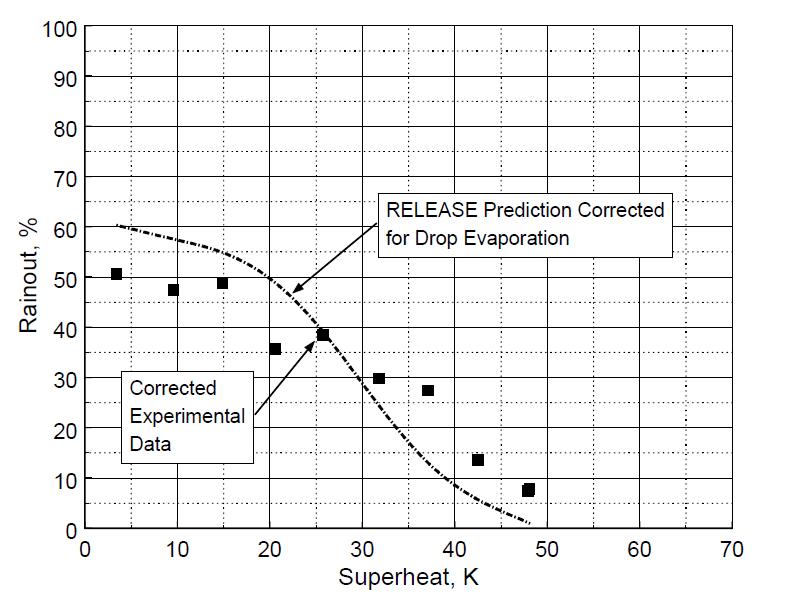
Figure 14
Comparison of RELEASE Prediction Corrected for Drop Evaporation and Methylamine Experimental Data

Figure 15
Effect of Release Height on Computed Rainout Fraction

Figure 16
Effect of Release Angle on Computed Rainout Fraction

Figure 17
Comparison of RELEASE Prediction Corrected for Drop Evaporation and Subcooled Release Conditions with Cyclohexane Experimental Data

References
- Abramowitz, M., and I. A. Stegun [Editors] (1965), Handbook of Mathematical Functions. Dover Publications, New York, 1965: p. 932.
- CCPS (1990), RELEASE Characteristics of Superheated Water and CFC-11 Liquids &mdash An Experimental Program. Prepared for the American Institute of Chemical Engineers, Center for Chemical Process Safety, Energy Analysts, Inc., Norman, Oklahoma, May, 1990.
- CCPS (1992), Release Behavior of Superheated Chlorine, Methylamine, and Cyclohexane. Prepared for the
- Center for Chemical Process Safety, Quest Consultants Inc., July, 1992.
- DOE (1981), Vaporization, Dispersion, and Radiant Fluxes from LPG Spills (Final Report). United States
- Department of Energy, Contract DE-ACO5-78EV-06020, December, 1981: pp. IV-1 through IV-10.
- Ianello, Victor, and C. P. Childs (1988), RELEASE User’s Manual. CREARE Inc., Hanover, New Hampshire, December, 1988.
- Iannelo, Victor, G. B. Wallis, and P. H. Rothe (1998),
- Johnson, D. W., and J. L. Woodward (1999), RELEASE: A Model with Data to Predict Aerosol Rainout in Accidental Releases. Center for Chemical Process Safety of the American Institute of Chemical Engineers, 1999.
- Liles, et al. (1986), TRAC-PF1/MODI:An Advanced Best t Estimate Computer Program for Pressurized Water Reactor Thermal Hydraulic Analysis. NVREG/CR-3858, 1986.
- Tan, M. F., and S. G. Bankoff (1985), On the Fragmentation of Drops. ASME 85-WA/FE-1, 1985.
Copyright © 1999, Quest Consultants Inc., 908 26th Ave., NW, Norman, Oklahoma 73069, USA
All rights reserved. Copyright is owned by Quest Consultants Inc. Any person is hereby authorized to view, copy, print, and distribute documents
subject to the following conditions:
- Document may be used for informational purposes only.
- Document may only be used for non-commercial purposes.
- Any document copy or portion thereof must include this copyright notice.