
By
John B. Cornwell
Presented At Mary Kay O’Conner Process Safety Center 1999 Annual Symposium
Beyond Regulatory Compliance, Making Safety Second Nature College Station, Texas October 26-27, 1999
Abstract
Over the past decade, several attempts have been made to develop computer models that would provide “real-time” information describing the evolution and travel of toxic or flammable vapor clouds. As with any tool, in this case a computer program, its limitations must be clearly understood if it is to be used effectively. This paper presents an overview of several available models, some of them defined as “emergency response” models. The paper discusses the models’ strengths and weaknesses, and presents examples of when the models would be helpful and those times when they would simply make the situation worse. For situations where the available models are not applicable, alternate approaches will be suggested.
Text
Introduction

The advent of powerful, small, personal computers has led many emergency response agencies to the conclusion that helpful, accurate, real-time information outlining the proper response to hazardous material releases is available during a response. But, is this true? This paper will try to answer this question through the use of three real-world examples.
Types of Models
For the purposes of this paper, the consequence models available today can be divided into three general categories: emergency response, planning, and research. Each type of model has certain characteristics that set it apart from the others.
Emergency Response Models
These models must require a minimum amount of input and produce results in a matter of seconds or minutes. These two requirements often force the model user to make rapid decisions about the input parameters, sometimes requiring “estimates” of critical input parameters for the sake of generating an answer in a very short period of time. Two of the more common emergency response models are CAMEO/ALOHA and ARCHIE.
Planning Models
These models are designed to provide reasonably accurate estimates of the potential hazards zone(s) generated by a release of flammable and/or toxic material. The models are not meant to be run during a crisis. In many cases, the input information will require the model user to look up material physical properties and process information. Some of the available models have undergone third-party review and produce consistent results over a wide range of conditions. In general, the models produce conservative results (based upon comparison of model results to the available test data).
These models are often used in the planning stage of a project in order to check plant layout, establish buffer zones with neighboring plants or the public, and satisfy regulatory requirements. Three models in this group that evaluate toxic, flammable, and explosive hazards are PHAST, CHARM, and CANARY.
Research Models
These models often require a significant amount of user supplied data. In general, the models are clumsy to run, requiring multiple programs to complete an analysis. The models produce much more information than that needed during an emergency. Some of the research models were designed for specific materials, release types, or release geometries.
The research models are often used to evaluate specific characteristics of a release. In many cases, the results from a model run may be site specific, thus limiting the user’s ability to apply the results to a more generalized case. The models are not designed to produce a conservative answer. In fact, some studies have evaluated model accuracy based on the ability of the model to match test data within a factor of two. Thus, a model that underpredicts a hazard zone by a factor of two is judged to be as “good” as a model that overpredicts a hazard zone by a factor of two. Clearly, this approach is unacceptable for use in emergencies. Many of the research models are available in the public domain. Some of the more common ones are SLAB, DEGADIS, and HEGADAS.
Emergency Response Model Capabilities
In order for a model to be useful during an emergency, it must be easy to operate, capable of modeling the situation at hand, and produce a conservative (if not accurate), easy to understand representation of the hazard in a very short period of time.
Examples of the Use of Emergency Response Models
Perhaps the best way to demonstrate the capabilities and shortcomings of emergency response models is through the use of three examples.
Example 1. Overturned road tanker of gasoline.
In this example, an ordinary road tanker of gasoline has overturned on an interstate highway access ramp. In the accident, the shell of the tanker was punctured and gasoline spills out onto the highway surface. An emergency call has been put in to the local fire department, and the fire trucks are on their way. Upon arrival, the response team has already collected the following information.
- Materialreleased=gasoline
- Amountreleased = unknown. Assume 8,000 gallons (80% of a 10,000 gallon tanker).
- Sizeofpool = roughly 50-75 feet in diameter, but some of the gasoline is in the roadside ditch.
- Gentle winds out of the north.
- Overcast day, 4:15 p.m.
Example 2. Release from an LPG storage bullet in a gas plant.
A call is received from OKIE LPG reporting that a large billowing white cloud is present in the storage area. The responders are on their way. Upon arrival, the response team knows the following.
- Materialreleased=LPG. Plant personnel tell them that the LPG mix is 95% propane and 5% n‑butane.
- Amountreleased=unknown. Plant personnel tell them that the bullet they think is releasing the
- LPG has a capacity of 30,000 gallons.
- Gentle winds out of the north.
- Partly cloudy morning, 4:15 a.m.
Example 3. Release from an anhydrous ammonia storage bullet in a creamery.
- A call is received from Bluebonnet Creamery reporting that a large billowing white cloud can be seen outside the refrigeration building. The responders are on their way. Upon arrival, the response team knows the following.
- Materialreleased=anhydrous ammonia.
- Amountreleased=unknown. Plant personnel tell them that the storage bullet has a capacity of
- 30,000 gallons.
- Gentle winds out of the north.
- Partly cloudy morning, 4:15 a.m.
In each of the cases listed above, the responders have a minimal amount of information to work with. There are many unknown factors; some of them may be important, but how is the responder to know what is important and what is not? Can a simple mistake or misinterpretation affect the response? Does the responder have time to collect additional data?
For the purposes of this exercise, we will review the input requirements for two emergency response models, ALOHA and ARCHIE, as well as one of the planning models, CANARY.
ALOHA User Input Requirements
Table 1 presents the ALOHA input requirements for each example. The model allows the user to skip certain inputs when setting up a case. If an input is skipped, a default value is inserted in the input data file. These optional input values are identified by regular type in Table 1. Certain input data are required to be input by the user and the program will not provide default values for such input. These inputs are listed in bold type in Table 1. In order for the user to reasonably describe the system, the following data must be input.
Table 1
ALOHA User Input Requirements
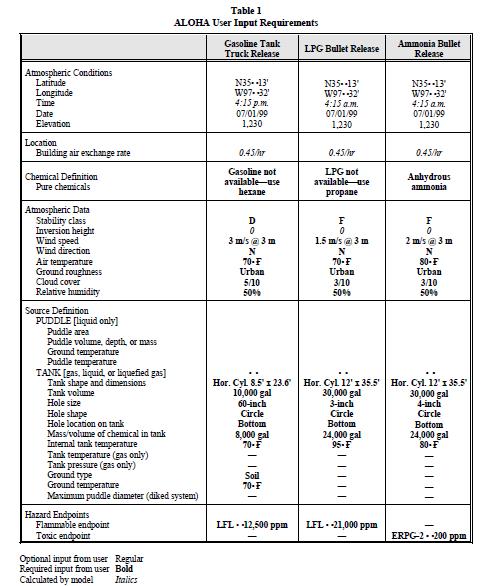
- Atmospheric conditions (wind speed, wind direction, stability, relative humidity, air temperature, and terrain description).
- Release material properties (gasoline is not available; thus, a substitute must be selected—the user chooses hexane. With the choice of hexane, the material properties are available from an internal data base of pure materials).
- Process or storage conditions (temperature of material, phase of material at release point, available inventory).
- Release geometry (hole size, hole shape, hole location on vessel).
ARCHIE User Input Requirements
Table 2 presents the ARCHIE input requirements for each example. Similar to ALOHA, the model allows the user to skip certain inputs when setting up a case. If an input is skipped, a default value is inserted in the input data file. These optional input values are identified by regular type in Table 2. The required user inputs are listed in bold type in Table 2. Although there are different options available within the ARCHIE input program to describe a system, the user must input the following data.
- Atmospheric conditions (wind speed, stability, relative humidity, air temperature).
- Release material properties (gasoline is not available; thus, a substitute must be selected—the user chooses hexane and inputs normal boiling point, molecular weight, liquid specific gravity, heat capacity ratio, vapor pressure, heat of combustion).
- Process or storage conditions (temperature of material, phase of material at release point, available inventory).
- Release geometry (hole size, discharge coefficient, release height [for toxics only]).
CANARY User Input Requirements
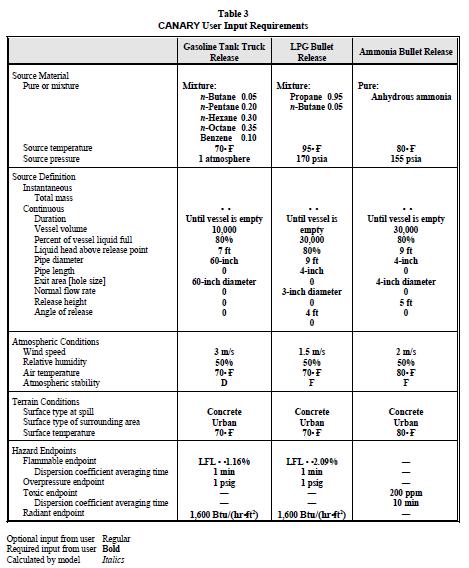
Table 3 presents the CANARY input requirements for each example. As a planning model, the user is required to enter all the pertinent data for any release evaluated. Thus, all the data listed in Table 3 are required and presented in bold type. In summary, the user must input the following data for the three example cases.
- Atmospheric conditions (wind speed, stability, relative humidity, air temperature, surrounding area description).
- Release material properties (a composition for gasoline and LPG can be entered—all physical properties for the mixture are internally calculated).
- Process or storage conditions (temperature and pressure of material at release point, available inventory).
- Release geometry (hole size, release angle, height of release).
Table 2
Archie User Input Requirements

Table 3
CANARY User Input Requirements
Missing Data – What You Don’t Know Can Matter!
Basically, the three programs ask the user for the same type of information: what is released, how is it released, and what are the local conditions during the release. For the emergency responders, the question becomes “What do I input for the things I don’t know?” For the ALOHA and ARCHIE models that may be employed at the accident scene or in a remote office, the following list of questions must be answered by the responders.
- Examples 1 and 2. What do we want to substitute for gasoline and LPG?
- Examples 2 and 3. Is the release from the vapor or liquid space of the vessel?
- Examples 1, 2, and 3. How much material is in the vessel?
- Examples 2 and 3. What is the pressure in the vessel?
- Examples 1, 2, and 3. What are the atmospheric conditions?
That still leaves the most important question that has to be asked.
- Examples 1, 2, and 3. How big is that hole?
This last question—How big is that hole?—is of critical importance. Besides the definition of the material (e.g., gasoline, LPG, or anhydrous ammonia), the size of the orifice releasing the material into the environment is the single most important model input. Knowing this, a review of the three releases in a different light is helpful.
Example 1. Overturned road tanker of gasoline.
The responder may not be able to see the size of the hole or puncture in the road tanker, but the size of the gasoline pool should be obvious. Since the system is not pressurized, the liquid is simply draining out of the tanker. The hazard is obvious; the size of the liquid pool can be estimated.
Example 2. Release from an LPG storage bullet in a gas plant.
OKIE LPG reported a billowing white cloud. When the responders arrive, there is still a billowing white cloud. Any pipework or equipment in the area further reduces an observer’s ability to “see” the release point. How is the responder supposed to determine the size of the hole? How can the responder know whether the release is originating from the vapor or liquid portion of the tank. Under certain conditions, a pressurized vapor release would also generate a billowing white cloud. Can the responder tell whether it is a 1-inch or 2-inch hole? Doubling the hole diameter quadruples the release rate for a liquefied gas release. Can the responder afford to make such a guess?
Example 3. Release from an anhydrous ammonia storage bullet in a creamery.
The creamery also reported a billowing white cloud. When the responders arrive, they are faced with the same dilemma as those responding to the LPG release. Where is the hole? How big is the hole?
Model Resultss
In order to review the information that the models produce, several assumptions will have to be made in order to complete the analysis. For the purposes of this exercise, we will
assume
the following.
Example 1. Overturned road tanker of gasoline.
- Hole size = 60 inches (the liquid is released almost instantaneously)
- Liquid inventory = 8,000 gallons
Example 2. Release from an LPG storage bullet in a gas plant.
- Hole is in liquid space of bullet
- Hole size = 3 inches in diameter (diameter of bottom connection)
- Vessel contains 24,000 gallons of liquid
- Vessel contents at 95°F
- Release orientation is horizontal and 4 feet above grade
Example 3. Release from an anhydrous ammonia storage bullet in a creamery.
- Hole is in liquid space of bullet
- Hole size = 4 inches in diameter (diameter of bottom connection)
- Vessel contains 24,000 gallons of liquid
- Vessel contents at ambient conditions = 80°F
- Release orientation is horizontal and 5 feet above grade
Data Entry and Model Output
Using the assumptions listed above, data entry can be completed for the ALOHA and ARCHIE emergency response and CANARY planning models. Once the data are entered, the models only require seconds to run. The output from the models can be summarized as follows.
Example 1. Overturned road tanker of gasoline,
The important model output for the gasoline tanker release is presented in Table 4. From Table 4, the following conclusions are drawn.
- ARCHIE and ALOHA present no information on the length of time the cloud travels downwind before diluting below the lower flammable limit (LFL).
- Even though this is a flammable liquid release, ALOHA presents no information on potential pool fire radiation or explosion overpressure hazards.
Example 2. Release from an LPG storage bullet in a gas plant (Table 5),
- ARCHIE and ALOHA present no information on the length of time the cloud travels downwind before diluting below the LFL.
- Even though this is a flammable liquefied gas release, ALOHA presents no information on potential torch fire radiation, explosion overpressure, or BLEVE radiation hazards.
Table 4&5

Example 3. Release from an anhydrous ammonia storage bullet in a creamery (Table 6).
- ARCHIE predicts that the ERPG-2 concentration level for ammonia (200 ppm) will travel 123,445 feet (23 miles) downwind. The output cautions that results over 20 miles are uncertain. If this result is accurate, of what use is it?
2. ALOHA provides no information on how much time it takes the cloud to reach its maximum downwind distance with a concentration above ERPG-2.
Table 6
Example 3: Anhydrous Ammonia Bullet Release

What happened to time?
A review of the ARCHIE and ALOHA results for the three example cases reveals the two critical failings of any real-time emergency response modeling. First, for the releases that have the potential to release a large volatile mass in a short period of time (e.g., liquefied gases), the responder has no way to determine the hole size. Thus, any guess that underestimates the true hole size results in potentially significant underpredictions of the flammable and/or toxic hazard.
The second missing critical output from ARCHIE and ALOHA is the hazard development and travel time. Without an estimate of when a cloud will reach specified distances, warning and/or evacuation procedures cannot be coordinated effectively.
Revisit Example Number 3. Release from an anhydrous ammonia storage bullet in a creamery.
Unlike the testing world, in the real world the accident occurs, the release starts, and then the response process begins. To demonstrate the effect this has on how decisions are made during an emergency response, the following time line is presented for Example 3, Release from an anhydrous ammonia storage bullet in a creamery.
What could have been done differently? Clearly, if the hole size was smaller, the release would have lasted longer. How would the responders know what size hole to enter into their program? How do you determine the hole size? A billowing white cloud would be generated from a ½-inch hole as well as a 4-inch hole. To demonstrate this point, Figure 1 is a picture of a release of anhydrous ammonia in an open outdoor setting.
Table 7
Time Line for Anhydrous Ammonia Release
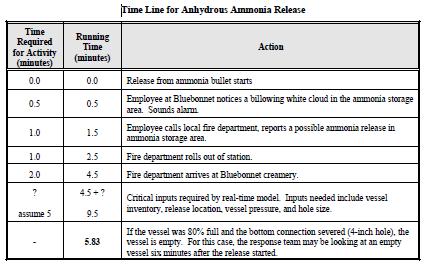
Figure 1
Outdoor Release of Anhydrous Ammonia

Can you tell the hole size from the picture? Figure 2 shows the source of the release. Can you tell the hole size? If this release were to occur amongst equipment, would it be easier to determine the hole size?
A similar time line for the LPG bullet can be constructed. The primary difference would be whether the flammable vapors ignited before the cloud reached its maximum extent. In the case of the LPG bullet, a 3‑inch hole was assumed; thus, the vessel would empty in about nine minutes.
Figure 2
Outdoor Release of Anhydrous Ammonia – Source Exposed

What can we learn from these three examples?
The three examples demonstrate the following fundamental points.
- For nonvolatile liquid releases, such as the gasoline tank truck, you don’t need a computer or a computer model. The source of the hazard is identifiable—it is the pool of liquid on the ground. The extent of the hazard should be understood by the local responders—a potential pool fire that could impact an area near the pool.
- For highly volatile releases, such as the LPG and anhydrous ammonia examples, it is virtually impossible for the responders to accurately assess the magnitude of the release. This is primarily due to the inability of the responder to
know
the size of the hole. If the responder cannot accurately identify the most critical parameter in the entire analysis, the results generated are unreliable and could make a situation worse (i.e., predict too small a hazard zone).
- Weather data are not important. The time spent gathering or estimating the local weather conditions for input into a model is of no real value during an emergency. The variance in the predicted hazard distances due to inaccurate weather data entry (e.g., 3 mph winds versus 6 mph winds, F stability versus C stability) pale in comparison to the variance in hazard predictions due to inaccurate estimates of hole size.
What is a responder to do?
During any emergency response, it is critically important that all of the personnel involved work off the same information. This information must be immediately available, concise, accurate, and easy to understand and implement. This definition of availability would rule out the use of computers for the example releases for the following reasons.
Example 1. Overturned road tanker of gasoline.
The responders arrive on the scene. The liquid pool is defined. The hazard zone has already reached it maximum extent. They know how to exclude the public from the scene. There is no need for a computer model.
Example 2. Release from an LPG storage bullet in a gas plant, and
Example 3. Release from an anhydrous ammonia storage bullet in a creamery.
The responders arrive on the scene. They cannot accurately define the source. An on-the-scene modeling session will take too much time and the results would be suspect. Decisions must be made without real-time modeling data.
Preplanning an Emergency Response – The Only Way to Go.
The use of consequence models to determine potential hazard zones should be used in a preplanning mode. As part of a hazards analysis, potential identifiable, credible releases should be modeled and the proper emergency responses designed. The key to this approach is being able to identify potential sources of releases. Returning to the ammonia example, the following parameters might be used to describe any ammonia release.
- The material is Ammonia.
- The release is Big or Small.
- The winds are Calm or Breezy.
- The winds are blowing toward the North (for example).
Once the responder or plant personnel identify these four parameters, the response would be defined, based on modeling studies already completed. No computer on the site is needed. No computer from which to retract information is needed. All responders could be working off the same preplanned response. Once the responder knows what material is involved and the direction the wind is blowing, he only requires definitions for two of the parameters—release size and wind conditions.
The definition of a big or small release size can be different for each material. This is due to a combination of material properties and storage conditions. One rule of thumb used for liquefied gas releases such as the LPG and ammonia examples in the paper is—if you cannot see the hole, the release is big. This allows the responder to make a rapid, conservative decision about the source.
The definition of the wind condition, calm or breezy, is handled in a similar manner. If the responder does not think the winds are breezy, he chooses calm. Once again, this will force a more conservative response.
The prepared responses for the four possible ammonia releases (big/calm, big/breezy, small/calm, small/breezy) must already be in the hands of the responders. The responses should address the following characteristics of the release and material.
- On-site and off-site effects
- Extent and duration of potential exposure
- Recommendations for sheltering-in-place, if applicable
- Road closures, if applicable
Other helpful but not critical information would include:
- Information on potential odors, if applicable
- Information on visual characteristics, if applicable
Ideally, the information would already be in the emergency response vehicles, plant headquarters (for releases from facilities), and other responders’ vehicles (police, sheriff, fire department, etc.). An example of such a presentation is presented in Figure 3 for a facility handling methylamine, a material similar to ammonia. If desired, this information can be overlaid on local maps in order to aid the responders in locating populations that may be affected. One way to present this information is illustrated in Figure 4.
Conclusion
The answer to the original question—Is real-time modeling during emergencies a good idea?—is clearly no. For the cases you could accurately model during an emergency, such as the gasoline tank truck release, you don’t need a model. For releases that require an immediate response, such as in the LPG and ammonia examples, the responder cannot assess the source quickly enough or accurately enough in order to predict the size of the hazard zone, thus limiting the responder’s ability to effectively manage his resources.
Figure 3
Summary of Emergency Responses for Methylamine Release

Figure 4
Graphical Representation of Methylamine Hazard Zones
