
By
Jeffery D. Marx and John B. Cornwell
Presented At
Energy Week ’96 Petro-Safe Conference Houston, Texas January 29 – February 2, 1996
ABSTRACT
The Environmental Protection Agency has proposed regulations that outline risk management program guidelines. The intent of these guidelines is to reduce the number and magnitude of accidents involving hazardous materials. The proposed regulations will require all facilities that process or store flammable or toxic materials in quantities greater than specified thresholds to register with the EPA, perform hazard assessments, and submit publicly available risk management plans (RMPs) to federal, state, and local authorities.
The offsite consequence analysis portion of the hazard assessment has been criticized for its definition of worst-case releases. The current proposal by the EPA (supplemental rule, March, 1995) defines the worst-case release as a release that fully depletes any hazardous material inventory in ten minutes. This approach oversimplifies the complex process involved in an actual release, and has the potential to severely underestimate or overestimate the extent of a specific hazard. This paper examines the issue of defining release rates, and illustrates how this definition can affect the outcome of the consequence analysis. The need for more sophisticated methods is demonstrated by calculating hazard zones for several ammonia storage system release scenarios. Results of this analysis show that the ten-minute spill duration may be appropriate for some cases, but is clearly inappropriate for others.
Text
Introduction

The Environmental Protection Agency’s Risk Management Program is scheduled to go into effect in the spring of 1996. Facilities that are covered by the rule, based on the List of Regulated Substances and Thresholds for Accidental Release Prevention, will have three years to comply with the new regulations. Each facility will be required to develop a risk management program, which must include a hazard assessment. The hazard assessment includes documenting the facility’s accident history for the past five years, and performing an offsite consequence analysis. The hazard assessment will be documented in a Risk Management Plan (RMP). The RMP document will be submitted to local, state, and federal authorities, and will be made available to the public. This will allow local emergency planning committees (LEPCs) or state emergency response commissions (SERCs) to interface with the facility in a more consistent and open manner.
When performing the offsite consequence analysis, each facility will be required to examine all onsite materials that are present in quantities exceeding specified thresholds. Within the RMP, “worst-case” and “more likely” accident scenarios will be reported for toxic, flammable, and explosive substances. All worst-case scenarios will involve a release of the maximum quantity of material stored, during worst-case weather conditions. Gas releases are defined such that the maximum quantity of stored material would be released in ten minutes. Liquid releases are defined in terms of a pool that would form in ten minutes, and the pool evaporation rate is used as the vapor release rate. This approach is similar to what is presented in the EPA’s 1987 publication, Technical Guidance for Hazard Analysis.
The EPA release and dispersion methodology presented in this paper follows the guidelines given in Technical Guidance. Although it provides a simple way to analyze a release at most facilities, this approach neglects many important properties of actual releases. As examples, this paper presents release and dispersion analyses for three sizes of anhydrous ammonia storage tanks. Release rates and downwind dispersion distances are determined using EPA methodology, and using more complex models. The results are compared to show the need for more sophisticated methods, and the importance of correctly defining a release scenario when examining a worst-case release.
Release Rate Issues
The EPA initially defined the worst-case release to be an instantaneous failure of the containment vessel. After receiving criticism concerning the definition of worst-case, the EPA now proposes that a worst-case scenario release the entire inventory of hazardous material in ten minutes. For vapor releases, the only factor involved in determining a release rate is the mass of material stored. Releases of materials stored as liquids above their normal boiling points (liquefied gases) are treated as gases upon release. For most liquids, including refrigerated materials, the release rate is simply the volatilization (or evaporation) rate from the liquid pool. This is determined by the liquid pool or diked area, and a material’s molecular weight, vapor pressure, and storage temperature. The examples and analyses presented here consider only a liquefied gas (ammonia), which the EPA methodology treats as a gas upon release.
In many consequence analysis studies, a credible worst-case scenario is usually modeled as a full rupture of the vessel’s largest piping connection. This simulates a broken pipe or a hole in the containment vessel itself. The fluid release rate is determined by the storage pressure and temperature, the hole size, and the physical and thermodynamic properties of the fluid. The EPA method ignores these variables by defining the release duration to be ten minutes and the release quantity to be the quantity stored, resulting in a constant release rate that depends only on the mass of material stored. For a release occurring through a hole in the storage vessel or through a broken pipe with no assumed length (i.e., friction and pressure drop are ignored), the storage conditions define the factors needed to calculate a more realistic release rate.
For a liquid stored above its normal boiling point (superheated liquid), a portion of the liquid will “flash” to vapor as the released fluid comes to equilibrium at atmospheric pressure. Rapid expansion of the vapor will break the remaining portion of the liquid stream into fine droplets. Larger drops may fall to the ground, but many remain suspended in the atmosphere as an aerosol. Aerosol droplets travel downwind with the vapor and eventually evaporate. The EPA method assumes that a superheated liquid changes entirely to vapor upon release, thus ignoring the properties of an aerosol cloud and the possibility of liquid falling on the ground. Although this assumption might produce the worst-case scenario for some releases, it may represent a situation that is not physically possible.
Example Cases
Three sizes of ammonia storage tanks were chosen to demonstrate the process of calculating release rates. Although the three tanks have different capacities, they all use the same size outlet piping. The ammonia is stored as liquefied gas (pressurized liquid at ambient temperature). Upon release, all the ammonia either flashes or becomes entrained in the vapor to form an aerosol cloud. Additional data for all three cases are presented in Table 1. In all three cases, the quantity of ammonia stored is well above the 10,000 lb threshold given by the EPA. These cases represent realistic storage sizes and conditions for ammonia storage at many facilities.
Table 1
Example Case Information

Comparison of Release Rates
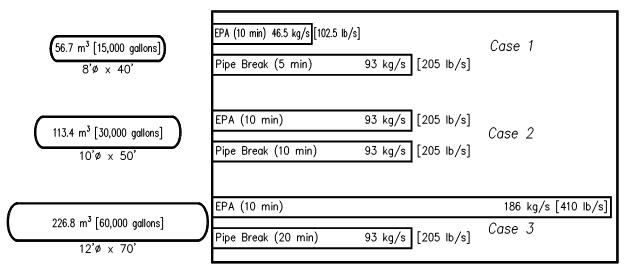
In accordance with the EPA method, release rates were computed by dividing the total amount of material stored by ten minutes (600 seconds). These values are presented graphically in Figure 1. Using a more complex model, which will be designated as the “pipe break” model, release rates were determined by using the thermodynamic and physical properties of ammonia, storage pressure and temperature, and the release hole area. The release rates computed by this method are also shown in Figure 1. From inspection of Figure 1, it is clearly seen that the pipe break method uses the release hole size when computing the release rate, and vessel inventory only affects release duration. Since the maximum connection size for all three cases is three inches, the release rate from all three pipe break cases is 93 kg/s (205 lb/s). Release rates for the three EPA cases focus on the quantity of material stored instead of the size of the release hole. This means that larger quantities of material will always produce larger hazards. Although possible, this is not necessarily a credible assumption.
Dispersion Models Used
Both the EPA and pipe break cases were modeled using a point-source Gaussian model and a momentum jet model, Ooms. Formulations for the point-source Gaussian model were taken directly from the Technical Guidance for Hazard Analysis, which also presents look-up tables for flow rate versus concentration endpoint based on the Gaussian model. When the desired concentration endpoint and release rate fall within the bounds of these tables, they may be used. Release rates for several of the scenarios presented here are greater than 10,000 pounds per minute, which exceeds the limit of the tables. Consequently, the equations given for the point-source Gaussian model were used to solve all the example scenarios for distances to concentrations at the release height. Variables include release rate, wind speed, gas concentration, and the horizontal and vertical dispersion parameters. The dispersion parameters are functions of downwind distance that vary with atmospheric stability class and terrain (rural or urban). When stability class, wind speed, concentration endpoint, and release rate are known, the equations are solved iteratively for downwind distance.
Figure 1
Release Rates for the Example Cases
Although simple, the point-source Gaussian model has many drawbacks. The model is insensitive to release duration, release velocity and orientation, material phase, thermodynamics, and release area, as well as other variables. This insensitivity severely limits the model’s use in any general application to varied release scenarios. The Gaussian model is also very sensitive to low wind speeds and stable atmospheric combinations, such as the conditions specified by the EPA for worst-case analysis. Worst-case weather conditions are defined by a wind speed of 1.5 m/s (3.4 mph) and an atmospheric stability of F (very stable). This model is well suited to look-up tables and provides a simple dispersion modeling scheme, but its results must be used with caution. In Technical Guidance, it is claimed that calculations resulting in distances below 0.1 mile and above ten miles are “not valid” for the model.
Ooms is a publicly available momentum jet dispersion model which was incorporated into the DEGADIS model, and is available from the EPA. The model used for this analysis has been modified to include aerosol thermodynamics and to enable jet releases at orientations other than vertical. Releases were set up with the rates and durations given in Figure 1. A surface roughness of 0.04 meters was used; this corresponds to long grass or crops and represents rural conditions. All cases were modeled as horizontal releases at grade from a three-inch diameter hole.
Comparison of Modeling Results
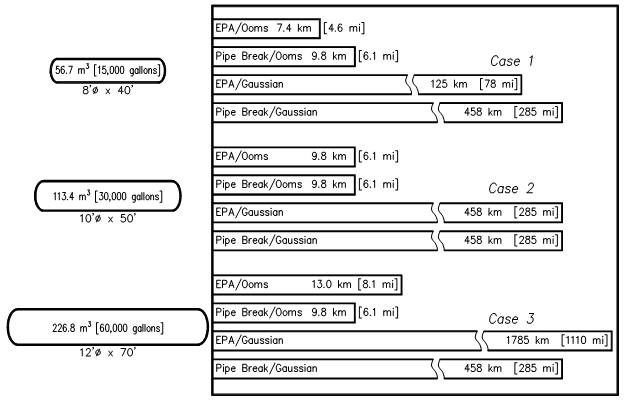
Dispersion results for the three example cases using the Ooms and Gaussian models are presented in Table 2. These results represent the worst-case accidents using the EPA’s definition of worst-case weather conditions. Both models were run using rural terrain conditions. Example calculations were performed to ERPG-2 and ERPG-3 levels. A comparison of distances to the ERPG-2 level is shown graphically in Figure 2. The ERPG endpoints have been defined by the American Industrial Hygiene Association (AIHA) as exposure levels that represent the threshold of serious or adverse health effects (ERPG-2) or potentially life-threatening effects (ERPG-3) for exposures up to 60 minutes. The EPA has suggested that one of these levels may be adopted as the toxic endpoint for use within the risk management program.
Table 2
Dispersion Modeling Results
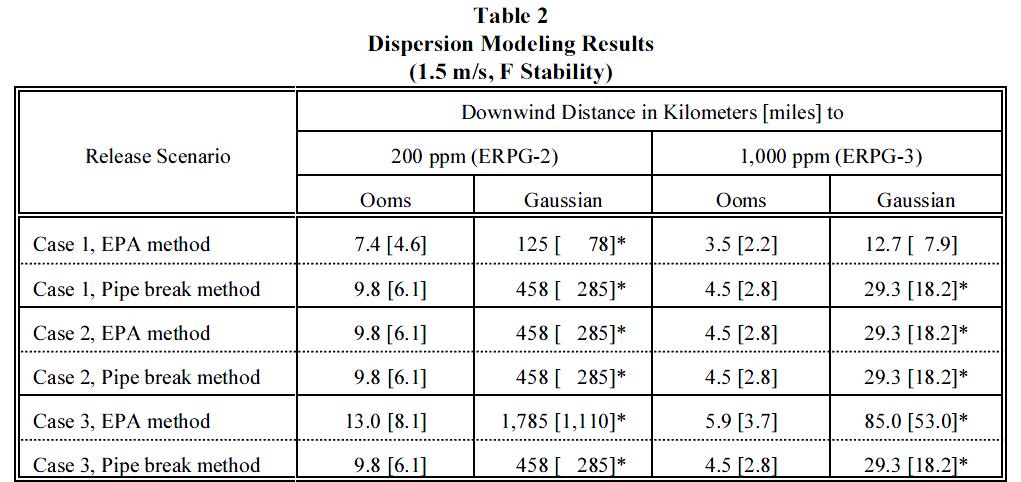
Figure 2
Downwind Dispersion Distances to 300 ppm NH3(ERPG-2)(Wind Speed ‘ 1.5 m/s; Stability ‘ F)
Calculations for “average” weather conditions, as defined in Technical Guidance, were also performed; these results appear in Table 3. These cases represent a more common wind speed of 5.32 m/s (11.9 mi//hr) and a “neutral” atmospheric stability of D. Both models were run using rural terrain conditions.
Table 3
Dispersion Modeling Results(5.32 m/s, D Stability)

Results in Tables 2 and 3, and Figure 2, illustrate how changes in the release rate affect dispersion calculations. Release rates determined by the pipe break model are based on the mechanics of fluid flow; therefore, they reflect the true release rates of liquefied ammonia from a three-inch hole. The EPA method will produce the true release rate only in specific situations. Case 2 was specifically designed to show how the EPA methodology can predict a reasonable release rate for a unique accident scenario; the tank size, hole size, storage temperature and pressure, and liquid level were chosen so that the true release rate would match a ten-minute release for the same mass of ammonia. Downwind dispersion results for Case 1 show how stretching the release rate over ten minutes for a smaller tank can produce an underprediction of the hazard zone, compared with a more realistic release rate. Allowing the release to take ten minutes artificially lowers the release rate for this example. Case 3 demonstrates an overprediction of the hazard when the stored material is artificially released at an impossibly high release rate. The simple variance of tank size (doubling and halving the size used in Case 2) causes the EPA methodology to produce misleading answers. Forcing a ten-minute release creates an accident scenario that is not based on a credible event. This often results in misrepresentation of worst-case accidents and produces results that vary significantly from those obtained using a more rigorous method. If an EPA-only methodology is used (ten-minute spill; Gaussian model), the variance in hazard distance predictions for the example cases becomes very large.
The ten-minute release, combined with look-up tables, provides a method that gives results with very little investment of time or effort, and occasionally these results may be acceptable. However, for many cases, reasonable answers will not be attained.
As seen in Tables 2 and 3, the Gaussian model consistently overpredicts the Ooms model for superheated releases of ammonia. The results in Table 2 emphasize the Gaussian model’s sensitivity to low wind speed and stable atmospheric conditions. When comparing the Gaussian results in Tables 2 and 3, this weakness is further exaggerated; the low wind and stable atmospheric condition distances are approximately one hundred times higher than those computed using a moderate wind speed and neutral atmospheric conditions. Results from the Ooms model show a threefold increase when comparing the low wind/stable conditions with moderate/neutral conditions. Gaussian distances, although longer, are within the same range as the Ooms distances for moderate/neutral conditions.
Under moderate/neutral conditions (Table 3), the Gaussian results seem reasonable. When examining results for low wind/stable conditions (Table 2), the Gaussian results are clearly not reasonable. If the EPA publishes look-up tables similar to those in Technical Guidance, many of the EPA/Gaussian combinations seen in Table 2 would produce an answer of “greater than ten miles.” This type of result is clearly inappropriate for RMP presentation, and will require more sophisticated methods to accurately model the release and dispersion.
Choosing a Dispersion Model
Before calculating hazard distances, all input variables for a dispersion model must be correctly defined. Once a credible release scenario is properly defined, a suitable model will produce reasonable results. To obtain consistent results, the user should carefully match the specific type of release (liquid spill, momentum jet, etc.) with a model designed for such a release.
Many public domain models are available for release rate calculation and dispersion analysis. Consulting firms who have proprietary models (such as the modified Ooms model used for this paper) may be retained to perform a hazard analysis. Whether a publicly available or proprietary model is chosen, care must be taken to ensure that the model is appropriate for the release scenario. For example, the EPA’s worst-case weather conditions can cause problems with many models; thus, it is a primary concern when selecting a model.
Conclusions
The risk management program proposed by the EPA will prove to be a challenge to any facility required to comply. The consequence analysis portion of the RMP document will be one of the most closely examined sections. The EPA has proposed a methodology that defines worst-case scenarios with a ten-minute release duration for the entire inventory of material. They have also suggested that look-up tables for determining downwind distances to specific hazard levels will be published. These tables will most likely be based on a Gaussian model, and will present downwind distances to various endpoints as a function of release rate. The EPA method may produce results that are acceptable for select cases, but most often it will over or underpredict the hazard.
One of the primary factors that influences the results from a dispersion model is the release rate. Use of the EPA’s simple ten-minute release duration will misrepresent many worst-case accidents. The scenario taken as a credible worst case does not necessarily empty the entire inventory of material in ten minutes. Using the ten-minute release can create situations where the risks posed by a facility on the public may not be correctly portrayed within the RMP. If variation from the EPA methodology is allowed, many methods and models are available that can better represent actual releases.
Choosing a model for any type of hazard calculation is not a simple decision. A full understanding of all the factors involved in a release is required. Hazard distances generated by models and presented in the RMP must accurately demonstrate the potential impact of a hazardous material release. Otherwise, regulating agencies and the public will develop a flawed perception about the risks that a facility poses. The proper representation and modeling of worst-case releases will put the apparent risk of a facility in proper perspective and allow the RMP to be an effective and trusted document.
References
- Supplemental Notice of Proposed Rulemaking, Accidental Release Prevention Requirements: Risk Management Programs under the Clean Air Act, Environmental Protection Agency, 60 FR 13526, 13 March 1995.
- List of Regulated Substances and Thresholds for Accidental Release Prevention, 59 FR 62262, 31 January, 1994.
- Technical Guidance for Hazard Analysis, Emergency Planning for Extremely Hazardous Substances, EPA/FEMA/DOT, December, 1987.
- DEGADIS – DEnse GAs DISpersion – Version 2.1, a report prepared for the U.S. EPA under EPA Contract 68-02-435.