
By
David W. Johnson, John B. Cornwell, and Jeffery D. Marx
Presented At 1998 Process Plant Safety Symposium Houston, Texas October 26–27, 1998
Abstract
Comparative Quantitative Risk Analysis (CQRA) is a useful technique for evaluating the effectiveness of proposed risk reduction strategies, without relying on an absolute risk target. This type of study can often provide decision makers with the information they require to either approve or deny project modifications.
This paper describes a CQRA study of a hydrogen fluoride (HF) alkylation unit. The objective of the study was to compare the level of risk to the public posed by the current configuration to that which would be posed following process upgrades and the installation of hazard mitigation systems.
Four HF alkylation unit configurations were evaluated.
- System 1 – Current configuration.
- System 2 – Modification of settler/cooler to include rapid deinventory system.
- System 3 – System 2 with the addition of a water spray curtain.
- System 4 – System 3 with the addition of remotely controlled water monitors.
The risk reduction potential of each mitigation system was calculated for each release “size” (leaks, punctures, ruptures). In addition, the overall effectiveness of each proposed mitigation system was calculated, allowing the three proposed systems to be ranked by risk reduction potential.
This paper outlines the approach to the study, tools used, mitigation efficiencies employed, and results obtained.
Text
Introduction

Quest Consultants Inc. performed a comparative risk analysis of existing and proposed hydrogen fluoride (HF) alkylation unit configurations. The objective of the study was to compare the level of risk posed to the public by HF releases from the existing HF alkylation unit with the level of risk which would be posed by similar releases from the HF alkylation unit following the installation of proposed hazard reduction (mitigation) systems.
Four alkylation unit configurations were evaluated.
- System 1 – Existing alkylation unit configuration.
- System 2 – Proposed alkylation unit configuration. New configuration would add an additional acid cooler, move the settler/cooler locations, and upgrade the HF unloading area. The new settler/cooler configuration would have a rapid deinventory system integrated into the equipment.
- System 3 – This system contains all the equipment in System 2, with the addition of a water spray curtain in the settler/cooler area.
- System 4 – This system contains all the equipment in System 3, with the addition of four remotely controlled water monitors.
Two types of potential public hazards are posed by accidental releases from the HF alkylation unit: toxic hazards due to formation of HF gas clouds, and fire hazards resulting from the formation and ignition of flammable hydrocarbon clouds. In this study, only the risk of exposure to toxic clouds was evaluated. The purpose of this paper is to describe the effectiveness of the proposed mitigation systems and the potential risk reduction they would provide.
Site Layout
Current and Proposed Alkylation Unit Configurations
Existing Alkylation Unit Layout
The layout of the existing unit (System 1) is presented in Figure 1. All major equipment in HF service is labeled. The bulk of the acid inventory is located in the storage drum, the settler, the acid cooler, and the piping between the settler and cooler. Smaller HF concentrations and volumes of acid are contained in the fractionator, the fractionator accumulator, the splitter column, and the acid rerun column. The acid unloading equipment is located near the southern boundary of the unit.
Proposed Alkylation Unit Layout
The proposed unit layouts (Systems 2, 3, and 4) add an acid cooler and an acid dump tank. The settler is moved from above the acid storage drum to above the acid dump tank. The bulk of the acid inventory is located in the storage drum, the settler, the two acid coolers, and the piping between the settler and coolers. As in System 1, smaller HF concentrations and volumes of acid are contained in the fractionator, the fractionator accumulator, the splitter column, and the acid rerun column. A new acid unloading system replaces the current system and is located near the southern unit boundary.
Proposed Mitigation Systems
Rapid Deinventory System
The acid settler in the new configurations (Systems 2, 3, and 4) will include remotely operated valves to deinventory the acid from the coolers, settler, and associated piping. The system is designed to remove the full acid-phase inventory from the coolers, settler, and piping in less than five minutes following activation. The deinventory system is designed to take acid from the bottom of the acid coolers and drain it, by gravity and available pressure, into a new acid dump drum which is capable of holding the acid and hydrocarbon contents of the settler, coolers, and piping.
Figure 1
Current Alkylation Unit (System 1) Equipment Layout

The benefit of the deinventory system is:
- It reduces the duration of a possible release by removing available inventory from the system.
The potential problems with the rapid deinventory system are:
- It is an active mitigation system. In order for the system to remove HF from the settler, coolers, and piping, the dump valves must be opened. The system is manually activated; thus, any human error associated with the activation sequence will affect the overall performance of the system.
- The system does not activate immediately. In order for the dump process to start, the following sequence of events must occur.
- The release must be identified.
- A decision to stop the unit and dump the settler, coolers, and piping must be made.
- The dump valves are manually activated from a remote location.
- As a minimum, three minutes are required to dump the acid.
Effectiveness of Rapid Deinventory System
The effectiveness of the rapid deinventory system is dependent on two primary factors: activation time and release size.
The following equation can be used to calculate the amount of time the acid phase will be released from the system.
HF(inventory) = leak rate · t(activation) + [leak rate + dump rate] − [t(release) − t(activation)]
where:
HF(inventory) = mass of acid-phase HF in settler, coolers, and piping (kg)
leak rate = mass rate of acid-phase HF escaping from containment (kg/sec)
dump rate = mass rate of acid-phase HF dumped once activated (kg/sec)
t(activation) = delay time between start of leak and dump activation (sec)
t(release) = total duration of acid-phase HF leak (sec)
Solving for t(release) yields
t(release) = (HF (inventory) + dump rate − t(activation)) ÷ [leak rate + dump rate]
The operator activation time was defined to be one minute for punctures (1-inch holes) and larger releases. For smaller leaks, the activation time was defined to be three minutes.
The dump system significantly affects the duration of the smaller leaks and punctures. The duration of the large hole scenario is not affected. This is simply due to the fact that by the time the dump system is activated (one minute), all of the acid has already been released through the large hole.
The choice of an accurate dump activation time t(activation) is critical to the dump system analysis. The shorter t(activation) is, the more effective the dump system becomes. However, since t(activation) is measured from when the release starts (which is random) to when the dump system is manually activated, response times of less than one minute for significant releases would be difficult to justify. Similarly, as the response time increases, and the delay between when the release starts and the dump system is activated becomes longer, the dump system becomes less effective.
Water Spray Curtain
The new configuration defined as System 3 will have a water spray curtain in the area of the acid coolers, settler, and associated piping. The water spray curtain is designed to spray 6,000 R/min (100 kg/sec) of water into the area. The purpose of the water spray curtain is to remove a portion of the acid from the aerosol cloud by absorbing the acid into the water droplets. The system will be remotely operated and activated manually.
The benefits of the water spray curtain are:
- It reduces the amount of acid remaining airborne by removing acid from the aerosol cloud.
- It dilutes liquid acid that falls to grade. By diluting the liquid on the ground, the potential for significant ground level clouds evolving from grade is significantly reduced.
- It adds turbulence to the local atmosphere, which aids in diluting the airborne acid concentration.
The potential problems with the water spray curtain are:
- It is an active mitigation system. In order for the system to remove HF from the release stream, the water curtain must be operating. The system is manually activated; thus, any human error associated with the activation sequence will affect the overall performance of the system.
- The system does not activate immediately. In order for the water spray curtain to start, the following sequence of events must occur:
- The release must be identified.
- A decision to activate the water spray curtain must be made.
- The system is manually activated from a remote location.
Effectiveness of Water Spray Curtains
Tests in which HF was released into water spray curtains were conducted by the Allied Corporation in 1986 [Blewitt, et al., 1987]. One result of the test program was the determination of how effective water sprays were in terms of removing HF from an evolving cloud. The effectiveness was measured by capturing the water spray as it fell to the ground and measuring its acidity. In other words, the effectiveness of the water spray is measured by its ability to make the HF end up on the ground near the point of release.
The mass ratio of water released in the curtain to HF released as an aerosol stream determines the effectiveness of the water spray curtain in capturing the acid. Intuitively, this makes sense; the more water you use, the more acid you capture. Similarly, if the acid release rate is low, then high water/acid rates result in high capture rates.
In order to use the test data for this analysis, a correlation that relates acid release rate to water curtain rate was developed. This correlation is presented in Figure 2, along with the Allied data. From a review of Figure 2, it is clear that once the water/acid mass ratio reaches about 70, further increases in the ratio produce only a minimal increase in effectiveness. It is also clear that small releases may be easily overwhelmed by the water curtain, thus yielding very high HF capture rates. The real test of the water curtain as a mitigation system occurs when it is put into operation on a significant release. As the water/acid mass ratio drops, the effectiveness of the water curtain decreases significantly.
Figure 2
Water Curtain Mitigation Effectiveness

As was the case for the rapid dump system, the time required to activate the water curtain plays a critical role in its effectiveness. Since the same identification and response procedure will be required for the water spray curtains as for the rapid dump system, the activation times are defined to be identical: one minute for punctures (1-inch) and larger releases, and three minutes for releases smaller than punctures. For releases from reactor/riser section piping, the acid removal efficiencies obtained with the 6,000 R/min water curtain are presented in Table 1.
Water Monitors
The new configuration defined as System 4 will have four remotely controlled, elevated water monitors installed around the perimeter of the alkylation settler/cooler area. Each of the four water monitors will have the ability to deliver 5,000 R/min (83.3 kg/sec) of water. The water monitors serve a dual purpose:
- Remove HF from the cloud.
- Induce turbulence.
As was the case with the rapid dump system and the water curtain, the water monitors will be remotely operated and manually activated.
The benefits of the water monitors are:
- They reduce the amount of acid remaining airborne by removing acid from the aerosol cloud.
- They dilute liquid acid that falls to grade.
- They add turbulence to the local atmosphere, which aids in diluting the acid concentration remaining airborne.
The potential problems with the water monitors are:
- It is an active mitigation system. In order for the system to remove HF from the release stream, the water monitors must be operating. The system is manually activated; thus, any human error associated with the activation sequence will affect the overall performance of the system.
- The system does not activate immediately. In order for the water monitors to start, the following sequence of events must occur.
- The release must be identified.
- A decision to activate the water monitors must be made.
- The system is manually activated from a remote location.
- Each individual monitor must be directed (aimed) at the release location, thus delaying its potential benefit. Visually locating the source of the leak may be difficult for larger releases since an acid and/or hydrocarbon cloud released from the unit will be opaque. This may further delay the benefit of the monitors.
- On average, only one of the four monitors will be fully able to direct its water spray into the affected area.
Effectiveness of Water Monitors
For this study, the effectiveness of the water monitors was based upon the ability of each monitor to introduce water into the released acid cloud. In this manner, the water monitors supplement the water curtain, but on a delayed basis. For the study, one minute was defined to be the time required to direct the water monitor toward the acid release point once the system was activated. For the large holes and punctures, this means that the time between the start of the release and the start of the water monitors to reduce the HF content of the cloud is two minutes (one minute to activate and one minute to orient). For leaks, the total time is four minutes (three minutes to activate and one minute to orient).
| Hole Size |
Total Airborne Mass Release Rate [Hydrocarbon and HF] (kg/sec) |
Airborne HF Mass Release Rate (kg/sec) |
Water Curtain Activation Time (min) |
Water Curtain Mass Rate (kg/sec) |
Water/HF Mass Ratio |
Modified Airborne HF Mass Release Rate (kg/sec) |
Percent Reduction in Airborne HF Mass Release Rate (%) |
|---|---|---|---|---|---|---|---|
| 6-inch | 333.0 | 260.0 | 1 | 100 | 0.38 | 260.0 | 0.0 |
| 1-inch | 10.0 | 8.0 | 1 | 100 | 12.5 | 5.6 | 30.0 |
| ¼-inch | 0.7 | 0.5 | 3 | 100 | 200.0 | 0.08 | 84.0 |
| Hole Size |
Total Airborne Mass Release Rate [Hydrocarbon and HF] (kg/sec) |
Airborne HF Mass Release Rate (kg/sec) |
Water Monitor Activation Time* (min) |
Total Water Mass Rate** [Curtain + Monitor] (kg/sec) |
Total Water/HF Mass Ratio [Water Curtain + Water Monitor] |
Modified Airborne HF Mass Release Rate (kg/sec) |
Percent Reduction in Airborne HF Mass Release Rate (%) |
|---|---|---|---|---|---|---|---|
| 6-inch | 333.0 | 260.0 | 2 | 183.3 | 0.71 | 260.0 | 0.0 |
| 1-inch | 10.0 | 8.0 | 2 | 183.3 | 22.9 | 4.2 | 47.0 |
| ¼-inch | 0.7 | 0.5 | 4 | 183.3 | 366.0 | 0.08 | 84.0 |
*Activation time for remote monitors increased one minute to allow for rotating monitor to hit” release location.
** Assumes only one of the four monitors (83.3 kg/sec) is fully effective in mitigating a release.
The effectiveness of the water monitors in further reducing the HF mass release rate can be seen in Table 2, which extends the analysis of the releases from the reactor/riser section to include the water monitors. Note that in this example, only one of the four available monitors is expected to contribute to reducing the acid flow rate.
Potential Hazards
A review of the refinery site layout, piping and instrumentation diagrams (P&IDs), and process flow diagrams (PFDs) resulted in the following range of credible HF releases, which have the potential to occur within the HF alkylation unit, with and without the mitigation features.
- Reactor/riser section
- Acid line from settler to cooler
- Acid line from cooler to acid pumps
- Acid line from pumps to settler and rerun column
- Rerun overhead line to settler
- Tank truck unloading line
- Hydrocarbon outlet line from settler
- Hydrocarbon line to fractionator
- Fractionator overhead line
- Fractionator accumulator liquid line
- Splitter feed line and fractionator reflux line
- Splitter overhead line to fractionator overhead receiver
- Acid line from accumulator to settler
- Hole in acid storage vessel
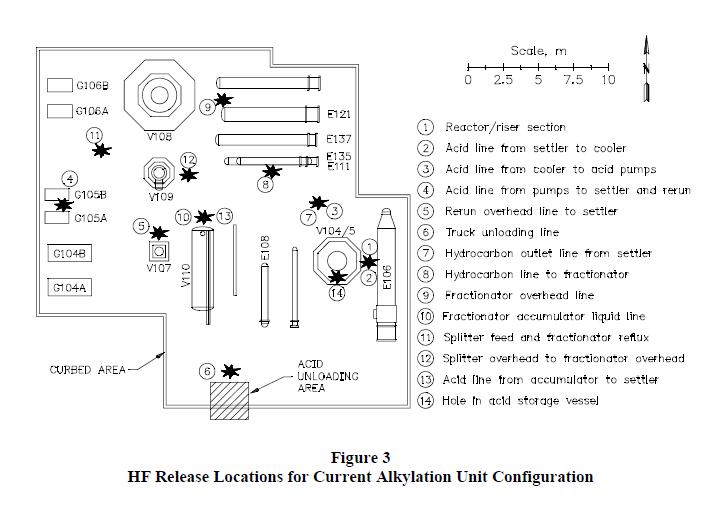
These release scenarios define a range of the most hazardous credible HF releases that might occur within an alkylation unit. A plan view of the existing alkylation unit configuration with the release locations identified is presented in Figure 3. A review of the fourteen releases identified, their locations in the alkylation unit configurations (Systems 1, 2, 3, and 4), and the effectiveness of the various mitigation systems determines how each potential release is modeled. For example, a release from the fractionator overhead line is not affected by the rapid dump system (it is not connected to the equipment), or the water curtain, or water monitors (the water resources are in the settler/cooler area). Thus, the HF toxic hazards posed by a release from the fractionator overhead line are about the same for each system configuration.
A release from the reactor/riser section is potentially affected by the rapid dump system, water curtain, and water monitors to various degrees. Many of the remaining twelve HF releases are affected by some, but not all, of the mitigation systems. Table 3 defines which releases are affected by which mitigation systems for each alkylation unit configuration evaluated.
Figure 3
HF Release Locations for Current Alkylation Unit Configuration
Toxic Release Calculations for System 1 – Current Configuration of Alkylation Unit
Dispersion analyses were performed to determine the extent of HF gas clouds resulting from the releases selected. These release scenarios involve holes in vessels and piping, seal failures, gasket failures, etc. All releases are assumed to last until the involved vessel’s acid-phase inventory is depleted (as is the case for the acid settler/cooler inventory) or for sixty minutes (as is the case for the gasket leak), whichever occurs first. For this study, sixty minutes is considered the upper time limit within which a leak begins, detection occurs, and corrective action is taken to stop the release. In light of uncertainties in the available experimental data and HF toxic probit equations in general, a minimum exposure time of five minutes was used in the study.
Toxic Release Calculations for System 2 – New Configuration with Rapid Dump System
Many of the process conditions for the releases identified changed as a result of the alkylation unit modifications associated with installing the additional acid cooler, etc. As a result of the change in the process conditions, all of the release/dispersion calculations were affected. In some cases, the process conditions were not significantly different, particularly in the fractionation section; thus, the hazard distances calculated were similar to those of the existing configuration.
In the settler/cooler area, the process conditions changed slightly, but the addition of the rapid dump system for the acid phase in the settler/cooler had a greater effect on the hazard distances. The ability of the rapid dump system to make a significant impact is dependent on both the magnitude of the release (e.g., hole size) and the time required to activate the dump system. The analysis showed that the dump system would not be effective in reducing the impact associated with a 6-inch release since the acid phase would be released into the atmosphere in less than one minute, which was defined to be the activation time for the dump system.
| Release From |
Current Configuration |
New Configuration | ||
|---|---|---|---|---|
| System 1 | System 4 | |||
| System 3 | ||||
| System 2 | ||||
| Affected by Dump System | Affected by Water Curtain | Affected by Water Monitor | ||
| Reactor/riser section | ✓ | ✓ | ||
| Acid line from settler to cooler | ✓ | ✓ | ✓ | |
| Acid line from cooler to acid pumps | ✓ | ✓ | ||
| Acid line from pumps to settler and rerun column | ✓ | ✓ | ||
| Rerun overhead line to settler | ✓ | |||
| Tank truck unloading line | ✓ | ✓ | ||
| Hydrocarbon outlet line from settler | ✓ | ✓ | ||
| Hydrocarbon line to fractionator | ||||
| Fractionator overhead line | ||||
| Fractionator accumulator liquid line | ✓ | |||
| Splitter feed line and fractionator reflux line | ||||
| Splitter overhead line to fractionator overhead receiver | ||||
| Acid line from accumulator to settler | ✓ | |||
| Hole in acid storage vessel | ✓ | ✓ | ||
The rapid dump system does have a pronounced effect on the hazard distances for punctures (1-inch holes) and leaks (1/4-inch holes). This is due to the reduction in the release duration. The shorter release duration defines the use of higher HF concentration through the use of the probit formulation. The higher HF concentrations are found closer to the source, thus reducing the overall extent of the hazardous cloud.
The addition of the rapid dump system would produce similar effects on the following HF releases:
- Acid line from settler to cooler
- Acid line from cooler to acid pumps
- Acid line from pumps to settler and rerun column
Toxic Release Calculations for System 3 – New Configuration with Rapid Dump System and Water Curtain
The proposed water curtain system affects potential releases in the immediate area of the settler and coolers. The ability of the water curtain to make an impact on the potential extent of an acid-phase release is determined by the magnitude of the release (size of the hole), as well as the activation time of the system.
The example provided earlier demonstrated how the water curtain would not provide any meaningful mitigation of large HF releases since the acid-phase inventory would be released into the environment before the water curtain could be activated. In addition, for the large releases, the water/HF mass ratios are too small to provide any significant benefit.
The water spray curtain does play an important role in reducing the amount of HF which remains airborne following a puncture or leak. The ability of the water curtain to remove HF from the release stream results in smaller source terms; thus, smaller acid clouds.
Toxic Release Calculations for System 4 – New Configuration with Rapid Dump System, Water Curtain, and Water Monitors
Four, tower mounted, remotely activated and operated water monitors are added to the System 3 configuration to arrive at System 4. Each of the four monitors has the ability to deliver 5,000 •/•min to a specified area. As was the case with the water curtain, the effectiveness of the water monitors is a function of the magnitude of the release and the activation time of the monitors. Since the actual time it takes a monitor to correctly direct its water into an HF cloud is defined as one minute following activation, the benefit of the water monitors is delayed.
The water monitors, like the water curtain, would not provide any beneficial mitigation of large HF releases since the acid-phase inventory would be released into the environment before the water monitors could be activated. In addition, for the large releases, the water/HF mass ratios are too small to provide any significant benefit.
The water spray monitors do play an important role in reducing the amount of HF which remains airborne following a puncture or leak. The ability of the water curtain to remove HF from the release stream results in smaller source terms; thus, smaller acid clouds.
Comparative Risk Analysis
In this study, the emphasis is on calculating the potential “exposure” to lethal HF gas concentrations. For this reason, toxic dispersion calculations were performed for a range of HF dosages representing 1%, 50%, and 99% mortality levels. The result of the analysis is then a prediction of the maximum extent and frequency at which someone may be exposed to a lethal toxic hazard due to an accidental release from one of the HF alkylation unit configurations.
Individual Risk Associated with Toxic Fluid Releases from Existing Alkylation Unit (System 1)
Combining the potential HF toxic hazard zones from releases evolving from the existing alkylation unit with the probability of occurrence and local weather data results in the individual risk contour plot presented in Figure 4. The contour lines in Figure 4 represent levels of individual risk of exposure to a lethal dose of HF for all HF releases evaluated. This figure is interpreted as follows. If an individual were located on the contour line labeled 10−6, that individual has a probability of 1.0×10⁻⁶ chance/year (one chance in one million per year) of being exposed to a lethal HF dose as a result of an HF release occurring within the existing alkylation unit.
Figure 4&5
Individual Risk Contours for Systems 4&5

Individual Risk Associated with HF Releases from New Alkylation Unit Configuration with Rapid Dump System (System 2)
The individual risk contour plot for all HF releases that originate in the proposed alkylation unit configuration incorporating a rapid dump system is presented in Figure 5. As can be seen from the plot, the outer risk contour (1.0×10⁻⁸) is actually larger than the 1.0×10⁻⁸ risk contour associated with the current system. This is primarily due to the additional acid handling equipment required by the new design (e.g., additional acid cooler, etc.). The hazard zones for the larger releases remain approximately the same since the acid dump system cannot be activated fast enough to affect the larger hole/rupture releases.
Individual Risk Associated with HF Releases from New Alkylation Unit Configuration with Rapid Dump System and Water Curtain (System 3)
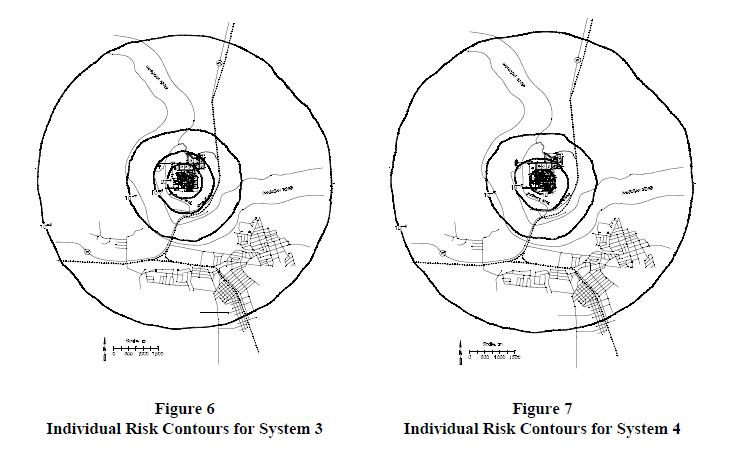
The individual risk contour plot for all HF releases that originate in the proposed alkylation unit configuration incorporating a rapid dump system and a water curtain in the settler/cooler area is presented in Figure 6. As can be seen from the plot, the outer risk contours are almost identical to those associated with System 2. This is due to the inability of the water curtain to effectively mitigate any of the large releases. The reasoning is the same as that for the dump system; the water curtain cannot be activated in time and, even if it were, the water/acid ratio would be so low that the water curtain would be ineffective.
Figure 6&7
Individual Risk contours for System 3&4
Individual Risk Associated with HF Releases from New Alkylation Unit Configuration with Rapid Dump System, Water Curtain, and Water Monitors (System 4)
The individual risk contour plot for all HF releases that originate in the proposed alkylation unit configuration incorporating a rapid dump system and a water curtain in the settler/cooler area and four remotely operated water monitors is presented in Figure 7. As was the case with the System 3 plot, the outer risk contours are similar to those associated with System 2. This is due to the inability of the water monitors to mitigate most of the large releases. The reasoning is the same as that for the dump system and water curtain; the water monitors cannot be activated and aimed in time and, even if they could, the water/acid ratio would still be low, thus providing no mitigation of most of the large releases.
Comparison of Individual Risk Levels Produced by the Existing and Proposed Mitigated Units
Comparing the extents of the individual risk contours between the existing and mitigated units is the most consistent method of evaluating the effect of design changes on the toxic risk. Individual risk contour plots represent the maximum extent of a lethal HF toxic hazard, as defined by the probit formulation, at which a potential exposure may occur at a defined risk level (e.g., 1.0×10⁻⁶, or one chance in 1,000,000 of exposure per year).
One way to compare the difference in risk posed by the existing unit versus the mitigated units is to compare the area potentially exposed to a specified risk level. As an example, Figure 8 presents the 1.0×10⁻⁶ individual risk level for all four alkylation unit configurations. For the current configuration (System 1), the total area exposed to a minimum risk level of 1.0×10⁻⁶ due to the existing unit is 3.93 km2, while the total area exposed to the same risk level due to the mitigated units (System 2, System 3, System 4) is 3.35 km2, 3.27 km2, and 2.36 km2, respectively. Thus, a 15% reduction in the area potentially exposed to an individual risk level of 1.0×10⁻⁶ is achieved with System 2, 17% with System 3, and 40% with System 4.
Similar calculations can be made for other individual risk levels. A summary of the area covered by each individual risk level is presented in Table 4.
Figure 8
1.0×10⁻⁶ Individual Risk Contours for Four Alkylation Unit Configurations

Study Conclusions Based on Individual Risk Contours
- When the transition from System 1 to System 2 (new configuration with dump system) was made, the following is observed.
- The extent of the 10−5, 10−6, and 10−7 risk contours became smaller (i.e., closer to the alkylation unit). This is due to the ability of the dump system to reduce the duration of the small and medium releases. The shorter duration results in smaller hazard zones due to the probit formulation for HF.
- The extent of the 10−8 risk contour becomes larger. This is due to two factors.
- The large releases are unaffected by the dump system because the HF is all released before the dump system is activated.
- With the addition of the second riser, downcomer, and cooler, the probability of an event has increased (due to more equipment). As a result, the risk due to a large event actually increases slightly.
- The transition from System 2 to System 3 (addition of water curtain) shows very little improvement in the individual risk contours. This is primarily due to the following two circumstances.
- The water spray curtain is effective on small releases, not large releases.
- For events when the water curtain mitigation is effective (leaks and some punctures), the mitigation system works well, but its usefulness is questionable since the HF clouds (mitigated or unmitigated by the water curtain) would not travel far enough to reach public areas anyway.
- The transition from System 3 to System 4 (addition of remote water monitors) does show improvement by reducing the extent of the 10−5, 10−6, and 10−7 risk contours. The following factors account for this behavior.
- The use of water monitors effectively increases the water/HF ratio, resulting in a greater HF scrubbing efficiency for a release. Thus, all the smaller, more frequent releases (leaks, punctures) are more effectively mitigated with the addition of water monitors than with just the water curtain.
- More releases are potentially affected by water monitors than by the water curtain.
- For larger releases, the combination of water curtain and water monitors suffers from the same fate as the water curtain alone. The water/HF mass ratio is still too low to achieve high scrubbing efficiencies.
- The extent of the 10−8 risk contour remains basically the same for Systems 2, 3, and 4. This risk level is dominated by low probability, large consequence ruptures, and large hole events that are unaffected by any of the proposed mitigation systems.
| Individual Risk Level (exposure/year) | Area (km2) Potentially Exposed to Individual Risk Level | ||||||
|---|---|---|---|---|---|---|---|
| System 1 | System 2 | System 3 | System 4 | ||||
| Existing Configuration | New Configuration with Rapid Dump System | Percent Decrease in Exposed Area Relative to System 1 | New Configuration with Rapid Dump System and Water Curtain | Percent Decrease in Exposed Area Relative to System 1 | New Configuration with Rapid Dump System, Water Curtain, and Water Monitors | Percent Decrease in Exposed Area Relative to System 1 | |
| 1.0×10⁻⁵ | 1.42 | 1.09 | 23 | 1.07 | 33 | 0.53 | 63 |
| 1.0×10⁻⁶ | 3.93 | 3.35 | 15 | 3.27 | 17 | 2.36 | 40 |
| 1.0×10⁻⁷ | 13.73 | 11.58 | 16 | 11.55 | 16 | 10.12 | 26 |
| 1.0×10⁻⁸ | 40.48 | 78.45 | −94* | 78.45 | −94* | 78.45 | −94* |
*Area potentially exposed to individual risk level increased relative to base case (System 1)
Summary
In summary, the comparative analysis resulted in three primary findings.
- Large releases lose HF inventory in a very short period of time, often less than one minute. When this happens, the response time of the mitigation systems becomes critical. Since the mitigation systems are to be manually activated, it is doubtful that the decision to dump and start the water spray resources will be made fast enough to affect the release duration. Thus, the hazards posed by ruptures and large holes will be the same for all alkylation unit configurations.
- All the proposed mitigation systems will help reduce the potential impacts that result from leaks and punctures in the alkylation unit. The activation times for the dump system and water spray resources are not as critical for the leaks and punctures as for the ruptures and large holes. The reduction in hazards associated with leaks and punctures will result in a lower overall risk.
- Ranking the three mitigation systems by their ability to reduce the overall toxic risk to the public due to the alkylation unit would result in the following:
- Rapid dump system (most effective)
- Remotely controlled water monitors
- Water curtain (least effective)
References
- Blewitt, D. N., J. F. Yohn, R. P. Koopman, and W. J. Hague (1987), “Effectiveness of Water Sprays on Mitigating Anhydrous Hydrofluoric Acid Releases.” International Conference on Vapor Cloud Modeling, November 2–4, 1987, Cambridge, Massachusetts.
Copyright © 1998, Quest Consultants Inc., 908 26th Ave., NW, Norman, Oklahoma 73069, USA
All rights reserved. Copyright is owned by Quest Consultants Inc. Any person is hereby authorized to view, copy, pring, and distribute documents subject to the following conditions:
- Document may be used for informational purposes only.
- Document may only be used for non-commercial purposes.
- Any document copy or portion thereof must include this copyright notice.